
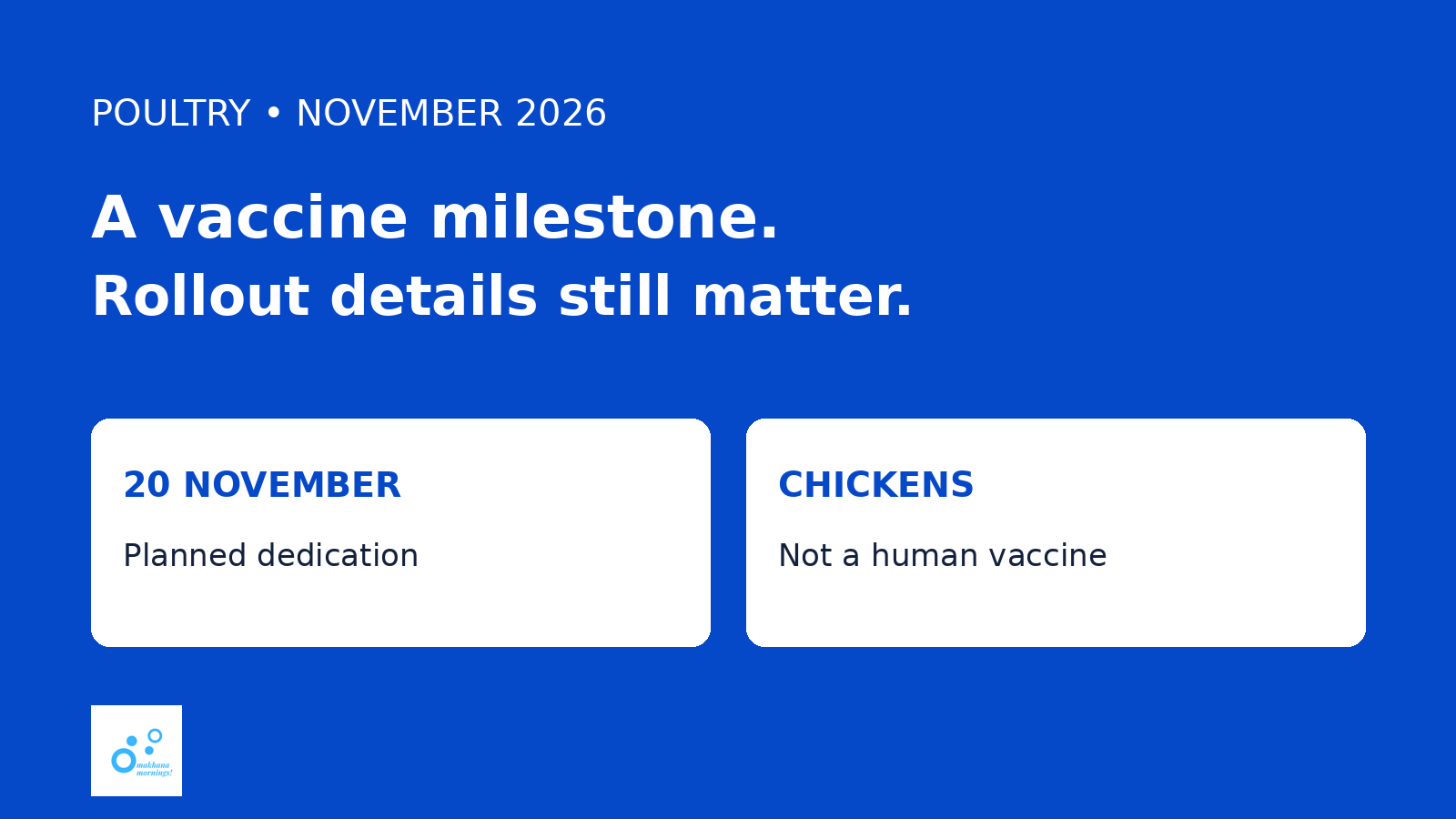
India’s agriculture ministry has announced a November 20 dedication of an indigenous H5N1 vaccine for chickens, developed by ICAR-NIHSAD in Bhopal. The milestone concerns poultry disease control, not a vaccine for people.
The November 18 government announcement identifies an inactivated vaccine targeting clade 2.3.2.1a, a particular branch of the H5N1 virus. It describes the product as India’s first indigenous vaccine of this kind.
Development is not the same as deployment
The release does not set out commercial availability, pricing, manufacturing volumes or a farm-level vaccination programme. Nor does it provide a quantified efficacy result. The scheduled dedication should therefore not be read as confirmation that poultry farms can already buy or administer it.
The ministry links the development to the losses caused by outbreaks, including culling and trade restrictions. Those are the business stakes, rather than evidence of savings already delivered by this vaccine.
The next questions are practical
In our reading, the useful follow-up is how a research milestone becomes a workable disease-control tool: who supplies it, under what deployment rules, and with what evidence and monitoring. A date for a ceremony cannot answer those questions.
For poultry producers, the announcement is a development to watch, not a basis for assuming that outbreak risk or operating costs have already fallen. The next meaningful update would be documented supply and deployment arrangements, rather than another headline describing the same planned event.




Leave your thoughts