
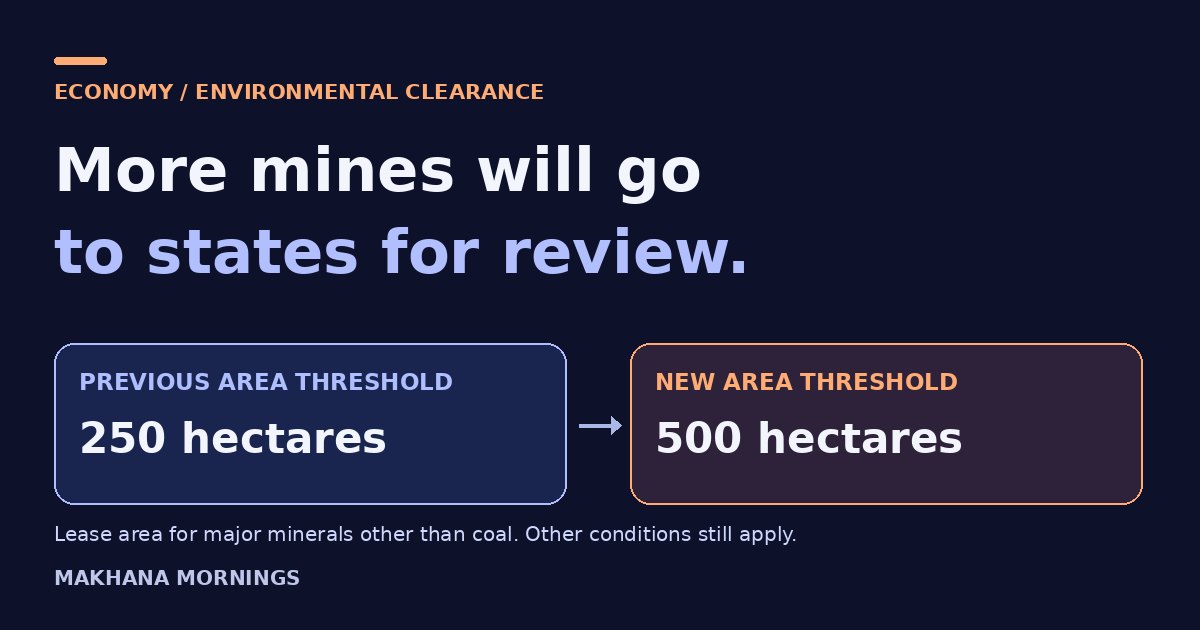
Take a proposed limestone mine with a 400-hectare lease. Until this month, the size of that lease put it on the central environmental clearance route. Under a change India’s environment ministry notified on 18 November, size alone no longer sends that proposal to New Delhi. If no other condition sends it to the Centre, the proposal can be considered at the state level.
The new threshold is 500 hectares of mining lease area
The amendment to India’s 2006 Environmental Impact Assessment notification raises the threshold for major-mineral mining leases other than coal from 250 hectares to 500 hectares. That changes the default review route for the band above 250 hectares and up to and including 500 hectares. Projects above 500 hectares remain on the central route by size. Coal already had a separate 500-hectare threshold.
On the state route, the State Expert Appraisal Committee examines the proposal and makes a recommendation. The State Environment Impact Assessment Authority decides on environmental clearance. The committee’s recommendation is not the same as the authority’s final decision.
Changing the reviewer does not remove the review
The November amendment changes the two area thresholds in the schedule. It does not, by itself, dispense with environmental assessment or public consultation where the rules require them. It also does not change separate provisions such as the central treatment of asbestos mining. Location-related conditions can still shift an otherwise state-level proposal to the Centre.
For someone following a specific project, a useful starting point is the lease area, followed by the project’s applicable category and location. The proposal, any hearing notice, the appraisal committee’s minutes and the final clearance order tell you different things. An agenda only shows that a committee is due to consider the proposal. It does not show that the mine has been cleared.
Watch the time to a decision and the conditions attached to it
The ministry’s stated purpose is to decentralise clearance. That does not establish that decisions will be faster or less stringent. Two outcomes will show more than the change on paper: how long a comparable proposal takes to move from application to decision, and what the authority requires the operator to do about issues such as water, dust and rehabilitation.
For a developer or a community trying to follow a proposed mine, the change is a reason to check which authority has the file. It is not a reason to assume the outcome.

Leave your thoughts