
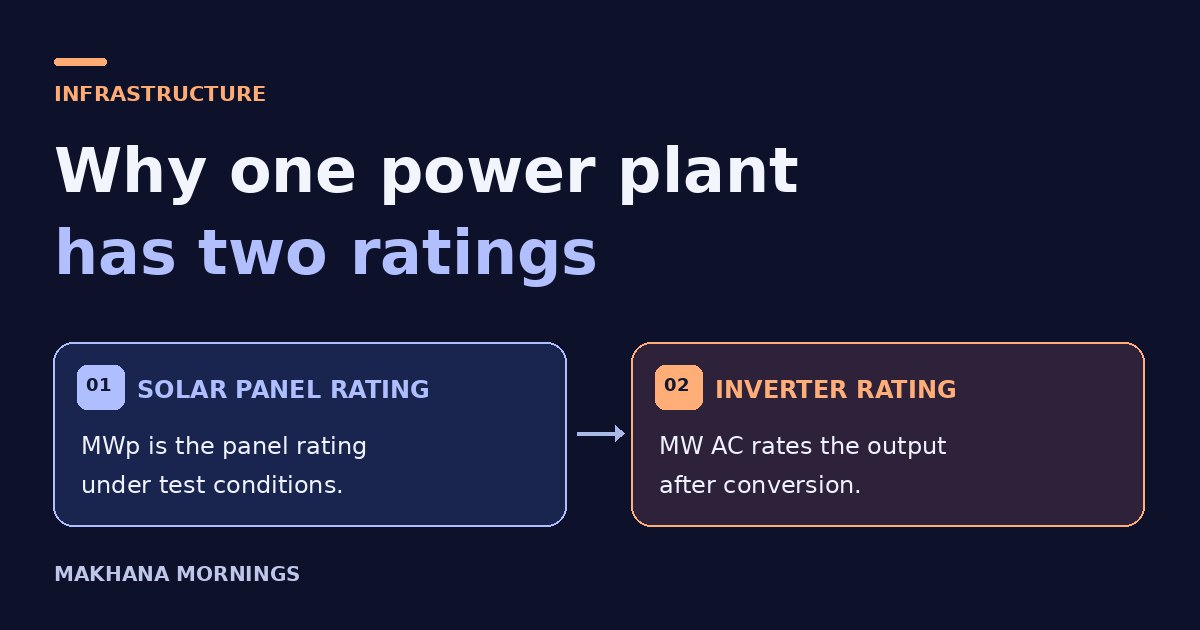
Juniper Green’s Gujarat wind and solar project is described as a roughly 120-megawatt plant. Its planned capacity is also about 152 megawatts-peak. The numbers look as if they contradict each other. They are two ways to rate the same project, not two amounts of electricity it supplies.
Juniper Green said on 22 November that its subsidiary, Juniper Green Spark Four, commissioned about 42 megawatts-peak (MWp) of additional solar capacity. The company said officials from two Gujarat power agencies witnessed the commissioning and that the formal certificate was still awaited. It now reports about 124 MWp commissioned out of about 152 MWp planned. That is a like-for-like comparison within the company’s reporting, not a statement that 124 MW can currently be sent to the grid.
Solar panels and the grid measure power at different points
A solar panel produces direct current (DC). Its peak rating tells you what it can produce under standard test conditions. The inverter converts it to alternating current (AC) for the grid. The inverter has its own rating, which can be lower than the combined peak rating of the panels. Developers may install more panel capacity so the inverter can work closer to its limit for more of the day, when sunlight is weaker.
For this project, Juniper’s July prospectus describes the full design as 120.30 MW on an AC basis and 152.02 MWp on its DC reporting basis. That second project-wide total includes the wind component; it is not the solar panels’ rating alone. The 42 MWp added in November, by contrast, is specifically a solar figure. The company’s update does not give the corresponding new AC figure.
Capacity tells you the scale, not what arrived at the grid
An update about commissioned capacity tells you which equipment has been brought into service. It does not tell you how much electricity was delivered or when it arrived. To answer those questions, look for metered energy in megawatt-hours and, if timing matters, how generation is distributed across the day. Wind and solar at the same project do not by themselves guarantee power around the clock.
The Crunch: Compare MWp with MWp to track commissioning. Use the AC rating to understand the project’s planned output capacity, and metered energy to find out what actually reached the grid.



Leave your thoughts