
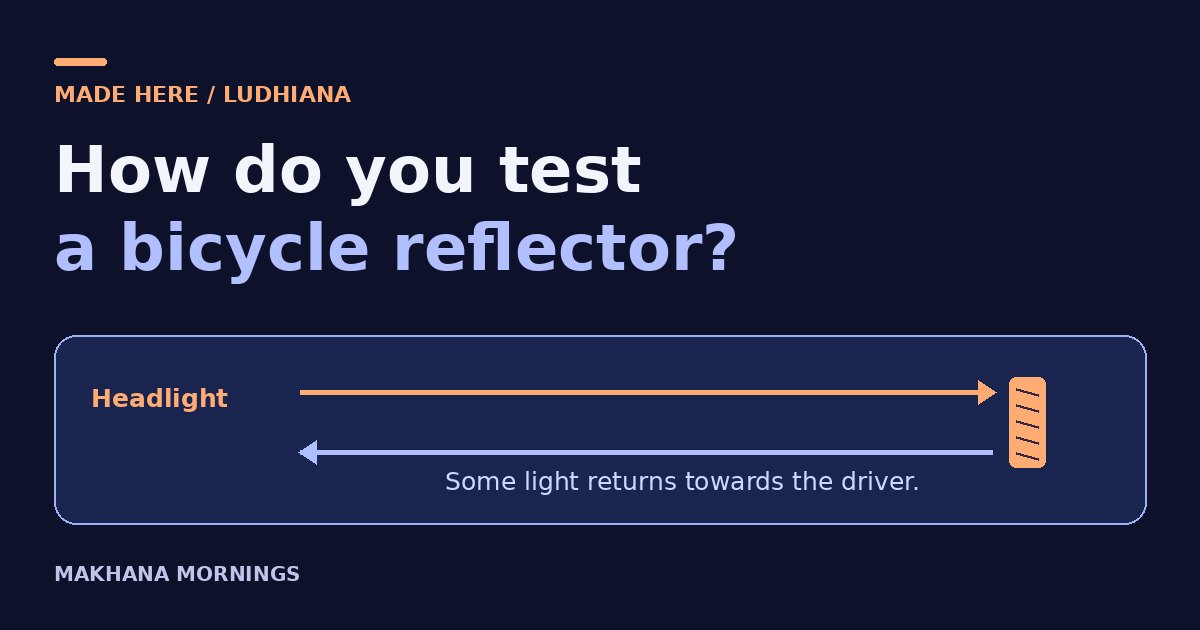
A bicycle reflector is small enough to hold in your palm. Testing it takes equipment that can measure how much light it sends back when a headlight approaches from different angles. For years, Ludhiana could make bicycles and their parts, but local manufacturers had to send reflector samples to labs elsewhere in India. A shared laboratory in the city’s Focal Point industrial area brought that test closer to the factory.
A reflector has to work when the driver is off to one side
A reflector does not generate light. It sends some of the light that hits it back towards the source. That matters when a driver’s headlights catch a bicycle from behind. A sample can look bright straight on and send back less light when the bike and car are at an angle to each other. Looking at the sample under a lamp cannot tell a manufacturer how well it performs across the angles used in the standard.
The Ludhiana centre uses a goniometer, an instrument that positions samples at controlled angles, and equipment that measures the light they return. The Bureau of Indian Standards lists checks for the amount of light returned and the reflector’s colour, plus temperature, impact and moisture tests within the centre’s listed scope.
The lab gives small manufacturers access to equipment they need only occasionally
The United Nations Industrial Development Organization documented the problem in its report on the first phase of the bicycle project. Sending samples outside Ludhiana meant higher costs and longer waits for reports. The project installed and commissioned dedicated equipment at the city’s Research and Development Centre for Bicycle and Sewing Machine and trained staff to use it.
Consider a small supplier developing a new rear reflector. If a prototype does not return enough light at one of the required angles, the supplier has to change its design and test again. A shared lab offers access to the instruments without tying up the supplier’s capital in equipment it may not need every day. The lab measures the sample’s performance. It does not redesign the part or guarantee that it will pass the next time.
A component test does not certify the whole bicycle
BIS treats the requirements for bicycle manufacturers separately. Its guidance for the bicycle manufacturer’s certificate of conformity includes a factory visit to check how the required marked reflectors are supplied and fitted. A test report on a reflector sample answers a different question from whether a bicycle manufacturer has met those requirements.
The wider lesson for other manufacturing clusters is to look for the tests that many firms need but few can justify doing in-house. A shared lab can put those tests within reach. The right measure of its value is whether firms can use the results to find problems and make better products, not simply how many machines the lab owns.


Leave your thoughts