
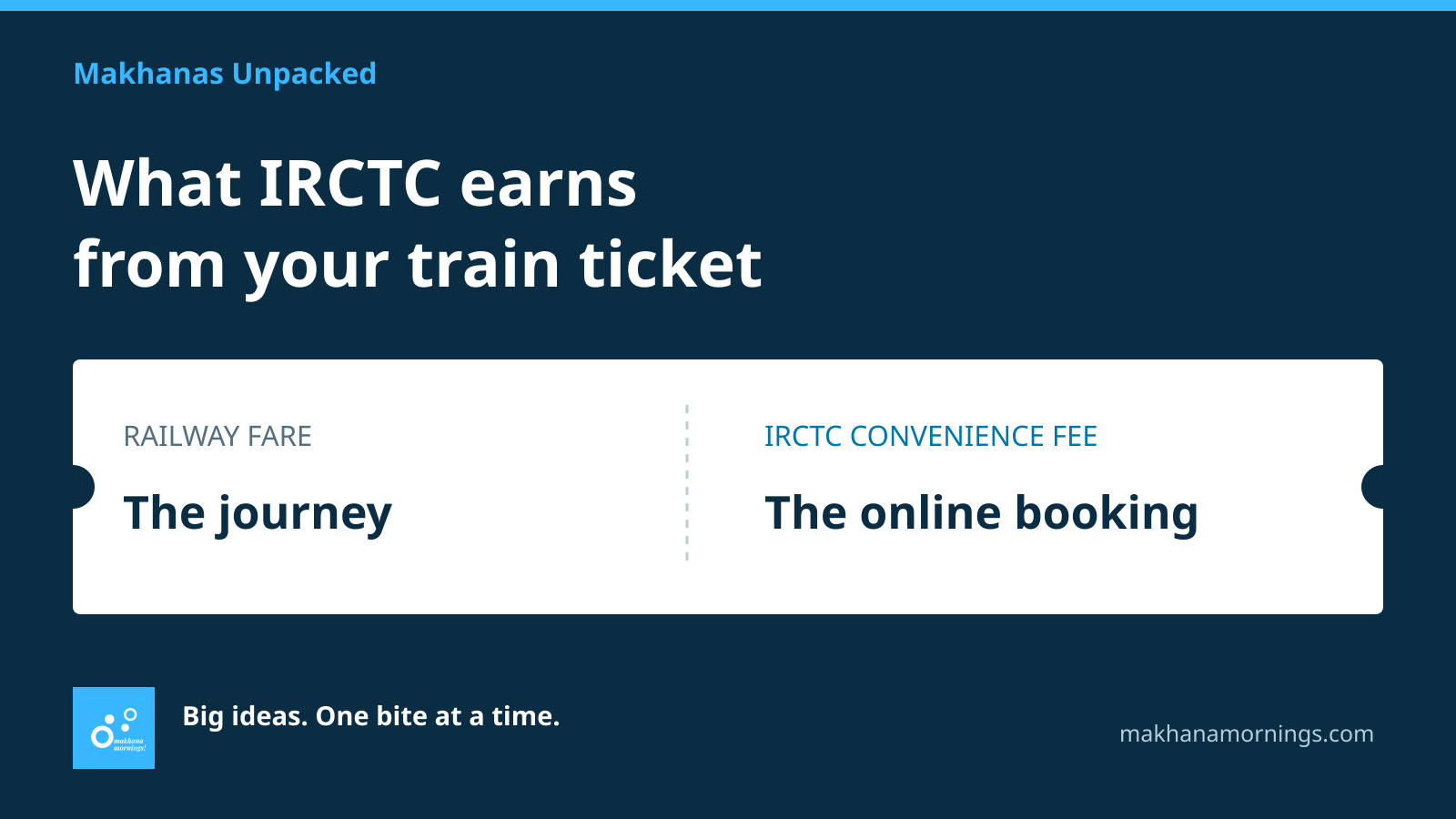
The amount you pay on IRCTC’s checkout screen combines different things. For an ordinary domestic reserved Indian Railways journey, the railway fare pays for travel. IRCTC earns a separate convenience fee for the online booking service. Treating the entire checkout amount as IRCTC’s sales would confuse the money passing through the platform with the money it earns.
That distinction explains a surprisingly familiar business. A booking can serve several passengers. A longer journey can cost more without changing the convenience fee. And the same company also has to manage very physical jobs, from meals to bottled water. Following those jobs is more useful than imagining IRCTC as the owner of every train on its website.
The visual explainer
Swipe through the visual explanation, or use the arrow controls. The full story continues below.


The Breakdown: two jobs behind one payment
Think of the booking screen as a checkout shared by a transport service and an online booking service. One provides the journey. The other lets you search availability, make a reservation and pay through the internet. The payment reaches one screen, but that does not make every rupee the platform’s revenue.
The Ministry of Railways says IRCTC’s convenience fee helps meet the cost of maintaining, upgrading and expanding the online ticketing infrastructure. The fee pays for that booking facility. It is therefore useful to keep the booking service separate from the journey when reading the bill.
There may also be tax, payment charges or an optional service shown at checkout. Read the itemised amount rather than assuming that every addition is another IRCTC booking fee. This explanation concerns ordinary domestic reserved railway e-tickets. IRCTC tour packages and its separately operated train products have their own commercial arrangements.
The unit is a booking, not a passenger
The convenience fee applies per ticket, or booking record, rather than separately to each passenger on it. That record has a PNR, the reservation reference. A family travelling on one booking therefore creates a different fee calculation from the same people making separate bookings.
Consider four people taking the same class with the same payment method. If they share one eligible booking, there is one convenience fee. If they make four separate bookings, there are four. This is an illustration of the charging unit, not advice to combine reservations when the passengers need different journeys or arrangements.
The payment method also matters
Standard fees before GST are ₹30 for air conditioned tickets and ₹15 for non air conditioned tickets. Bank account UPI reduces these to ₹20 and ₹10. UPI funded by a credit card or credit line uses the higher rates. These fees do not rise as a percentage of the fare.
Imagine two otherwise comparable AC bookings paid by bank account UPI, with fares of ₹1,000 and ₹2,000. Those invented fares illustrate the point: the stated convenience fee remains ₹20 before GST in both cases. Doubling the fare has not doubled this fee. Any other checkout charges still need to be considered separately.
A cancelled ticket and a failed booking differ
If a successful booking is later cancelled, IRCTC’s terms say the convenience fee is not refundable. The railway fare refund follows the applicable railway rules. The cancellation or clerkage deduction and the already paid convenience fee are separate items, even when the passenger sees one final refund.
A failed reservation is different. IRCTC’s published refund rules say that when the account is debited but no ticket is issued, the fare and convenience fee are refunded. Bank or card transaction charges may be lost. The distinction is whether a booking succeeded, not simply whether the passenger eventually travelled.
The company continues beyond the booking screen
IRCTC reports four business segments: catering, internet ticketing, Rail Neer, and tourism and train operations. A meal, a bottle of water and a holiday package involve different work from processing a reservation. The company’s wider business therefore cannot be understood from the convenience fee alone.
A booking platform can use the same software for many transactions, although it still needs reliable capacity, security and support. A physical product requires another unit to be prepared and delivered each time someone buys it. A travel package requires the promised services to come together for the traveller. These differences help explain why similar revenue growth can require very different effort and spending.
For the year ended March 2026, IRCTC reported roughly ₹2,399 crore of catering revenue and ₹1,536 crore from internet ticketing. These are segment figures from a completed financial year, not the value of all railway fares booked through its system. Internet ticketing revenue also includes advertising and partner or agent income.
The Crunch
When you next book a train, ask what each line on the bill is paying for. Then ask what changes the company’s earnings: another booking, a different payment method, a meal, a bottle or a package. The checkout total describes your spending. Understanding the service behind each charge explains the business.


Leave your thoughts