
A staffing firm can win a three-year contract and still face a question before its first invoice goes out: how many paydays will it have to cover before the customer pays? The answer can matter as much to the team running the contract as the price they bid.
Krystal Integrated Services disclosed on 21 November that Maharashtra’s Commissionerate of Health Services had awarded it a contract to supply skilled and unskilled workers to the state’s Public Health Department. The award is estimated at ₹144.70 crore before taxes and runs from 15 December 2026 to 14 December 2029. Krystal did not disclose how many people it will place, whether there is an advance or when it can expect to collect its first invoice.
A hospital tender shows why payday can come first
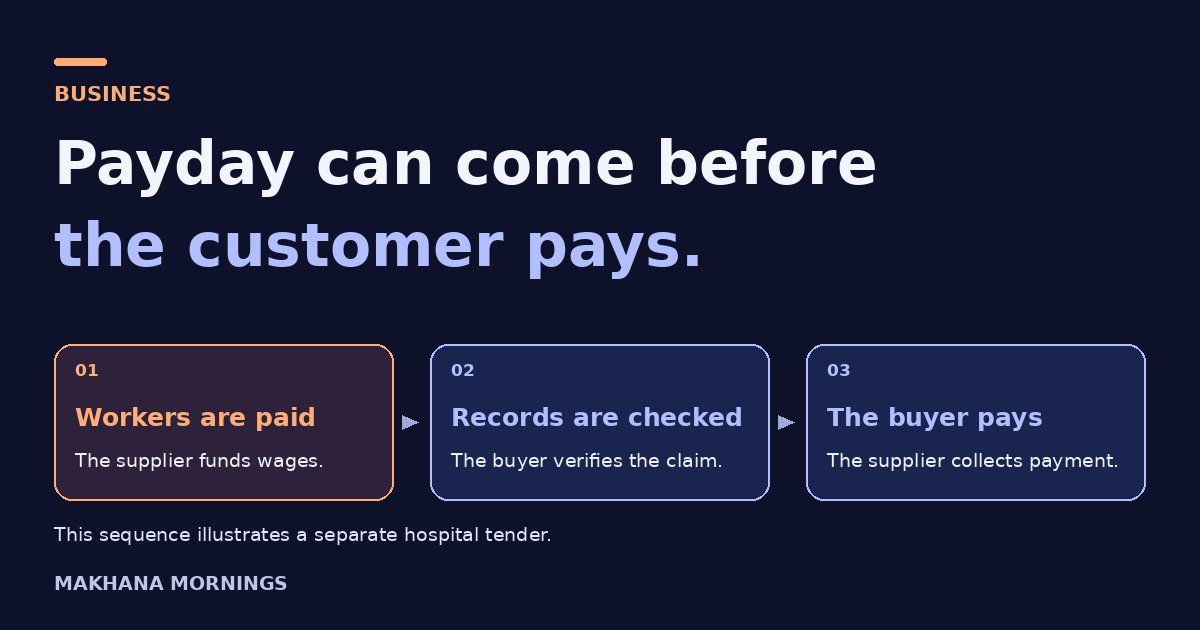
A separate tender at ESIC Hospital in Ezhukone, Kerala, shows how the timing can work. Under that tender, the contractor has to pay workers by bank transfer by the seventh of the following month, whether or not the hospital has paid the contractor. For the monthly bill, the hospital asks for verified attendance and proof that wages and social contributions were paid. It aims to pay within 15 days of receiving a complete bill.
The 15 days is a target in that tender, not a record of how fast the hospital pays. And the Kerala terms are not Krystal’s terms in Maharashtra. The example shows why the paperwork matters: if an attendance record needs correction, the buyer may not yet have a complete invoice, but the workers’ payday does not move.
The gap gets bigger when another payday comes first
Working capital is the cash the staffing firm needs to keep operating while it waits to be paid. Imagine a supplier owes ₹10 lakh in wages a month. If the buyer pays after one payday but before the next, the supplier needs to cover ₹10 lakh in wages in the meantime. If a delay pushes the first receipt past the second payday, that rises to ₹20 lakh before contributions and other costs. The wage bill per month has not changed. The number of payrolls the supplier has to fund has.
This is why an operations lead needs more than the payment term on the front of the contract. They need the first date workers are paid, the documents that make the first invoice complete, and a cash forecast that shows what happens if a missing record delays collection. The buyer also has a role: quick attendance sign-off can stop an administrative delay from becoming a funding problem for the supplier.
What to look for in the next staffing award
Ask how many payroll dates fall before the first customer payment, then run the same calculation with one invoice delay. The difference tells you more about the cash needed to start the job than dividing a three-year award by 36.
Read next: Why winning an order and having the financial capacity to execute it are two different things.



Leave your thoughts