
Buying a business can add technology and customers immediately. Turning those additions into a more profitable operation takes longer. Motherson’s latest India ambitions sit between those two stages.
In an interview published on November 15, Samvardhana Motherson International’s management said it wanted to bring technologies acquired globally to India. Its recent disclosures provide a useful way to examine that ambition: distinguish existing Indian production from future expansion, and acquired sales from improvements in performance.
The Breakdown
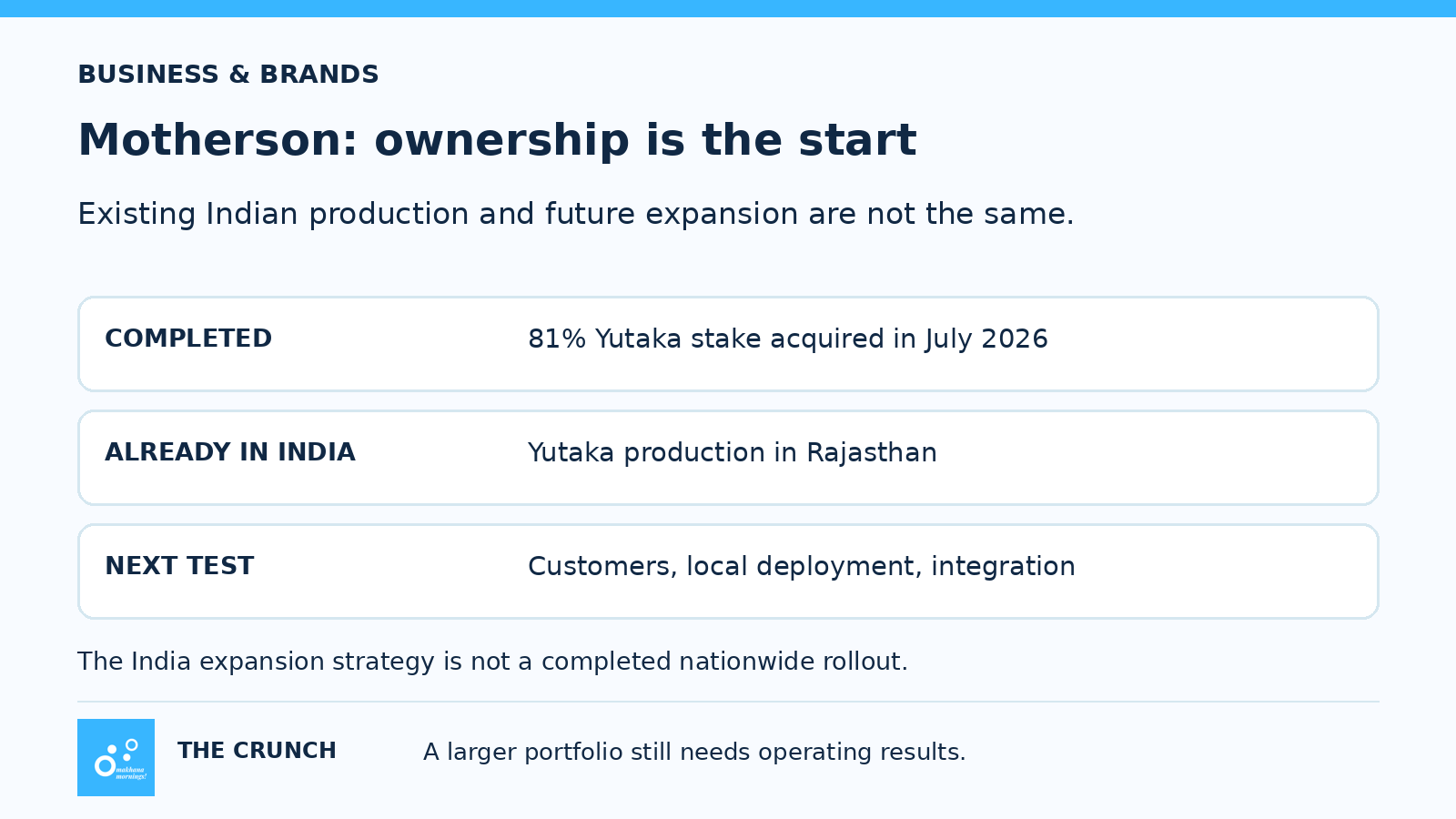
Yutaka offers a concrete example. Motherson’s September-quarter financial results record the acquisition of an 81% stake in Yutaka Giken on July 21. It is an acquired business, not simply an announced partnership.
And its Indian footprint is not hypothetical. Yutaka’s corporate directory identifies an operation in Rajasthan’s Tapukara industrial area, listing brake discs and car exhausts among its products. Its product information also identifies India as a brake-disc production base.
That matters because the India story is not necessarily about introducing an entirely new capability into the country. It can also mean bringing an existing Indian operation into a broader group, then seeking more customers or additional business. Those further gains still need evidence.
Bigger does not automatically mean more profitable
Motherson’s November 5 results release reported quarterly revenue of ₹38,280 crore, up 27% from a year earlier. Management attributed the growth mainly to the additions of Autoelectric and Yutaka, alongside strength in wiring harnesses.
On the earnings call, it put the group’s EBITDA margin at 8.8%, compared with 9% a year earlier, and attributed the decline primarily to integrating newly acquired businesses. EBITDA measures earnings before interest, tax, depreciation and amortisation.
Management also said margins improved when acquisitions were excluded. That is an important qualification: the reported group margin and the performance of the pre-existing businesses can move differently when the mix changes.
What India should watch
The useful evidence from here will be specific: which products enter local production, which customers order them, and whether the acquired businesses improve their operating performance. Ownership of a technology portfolio is not, by itself, evidence that every product has been deployed in India.
Yutaka provides an existing manufacturing example. The broader promise of bringing more global capabilities to Indian customers remains a strategy to be delivered, rather than a completed nationwide rollout.
The Crunch
Motherson has expanded what it can offer. The next test is what that broader portfolio delivers, in Indian production and in the performance of the businesses it has bought.
Leave your thoughts