
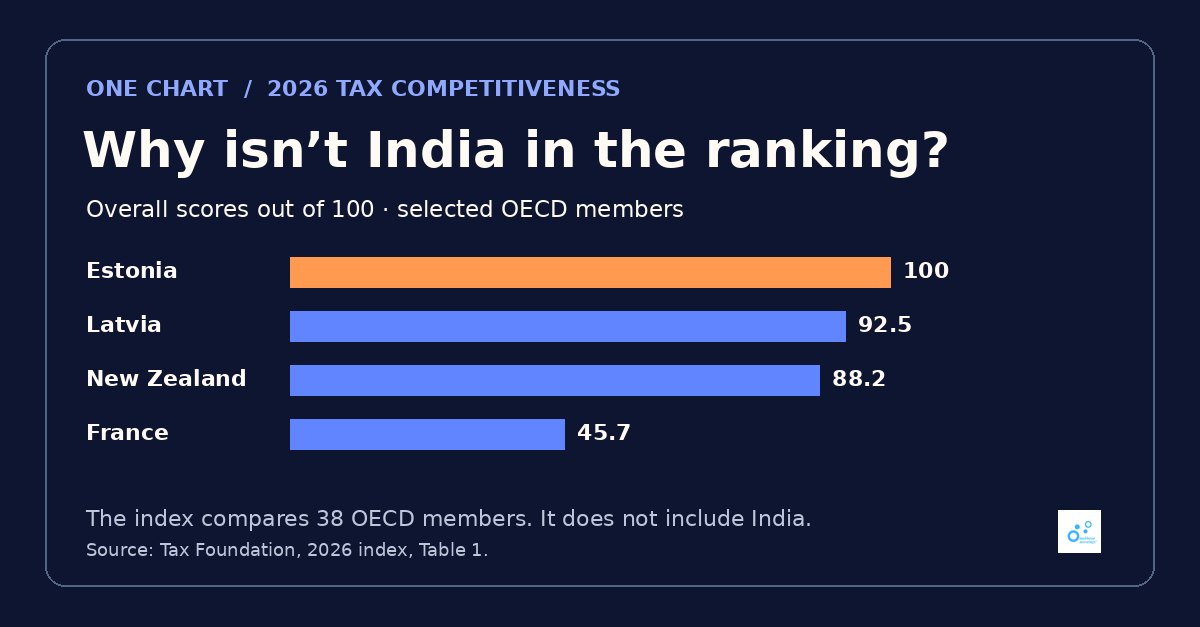
Estonia came first in the Tax Foundation’s 2026 International Tax Competitiveness Index. It came 24th on consumption taxes. Those results do not contradict each other: one ranks the country across five areas of tax policy, while the other looks at just one. And India was not assessed at all.
See the selected country scores on One Chart.
What the tax index measures
The index compares corporate, individual, consumption, property and cross-border tax rules across 38 OECD members. The scoring rewards rules that the Tax Foundation judges to create fewer distortions in choices such as whether to spend, save or invest. Estonia’s 100 is the highest score on that scale, not a tax rate, and Latvia and New Zealand follow at 92.5 and 88.2.
Estonia also illustrates why the rules matter as much as the headline rate. It generally taxes corporate profit when companies distribute it rather than when they earn and retain it. That is one feature the index rewards. The scores do not show how much people actually pay, how fairly the burden is shared, or what public services taxes fund.
Why India isn’t on the list
India has been an OECD Key Partner since 2007, but it is not a member. The Tax Foundation’s comparison covers members, so India has no score. It is outside the study, not below France, which ranked last among the 38 countries assessed.
The Crunch: Before comparing tax rankings, ask which countries were eligible and what the score rewards. A comparison of tax rules is not a comparison of what households pay.

Leave your thoughts