
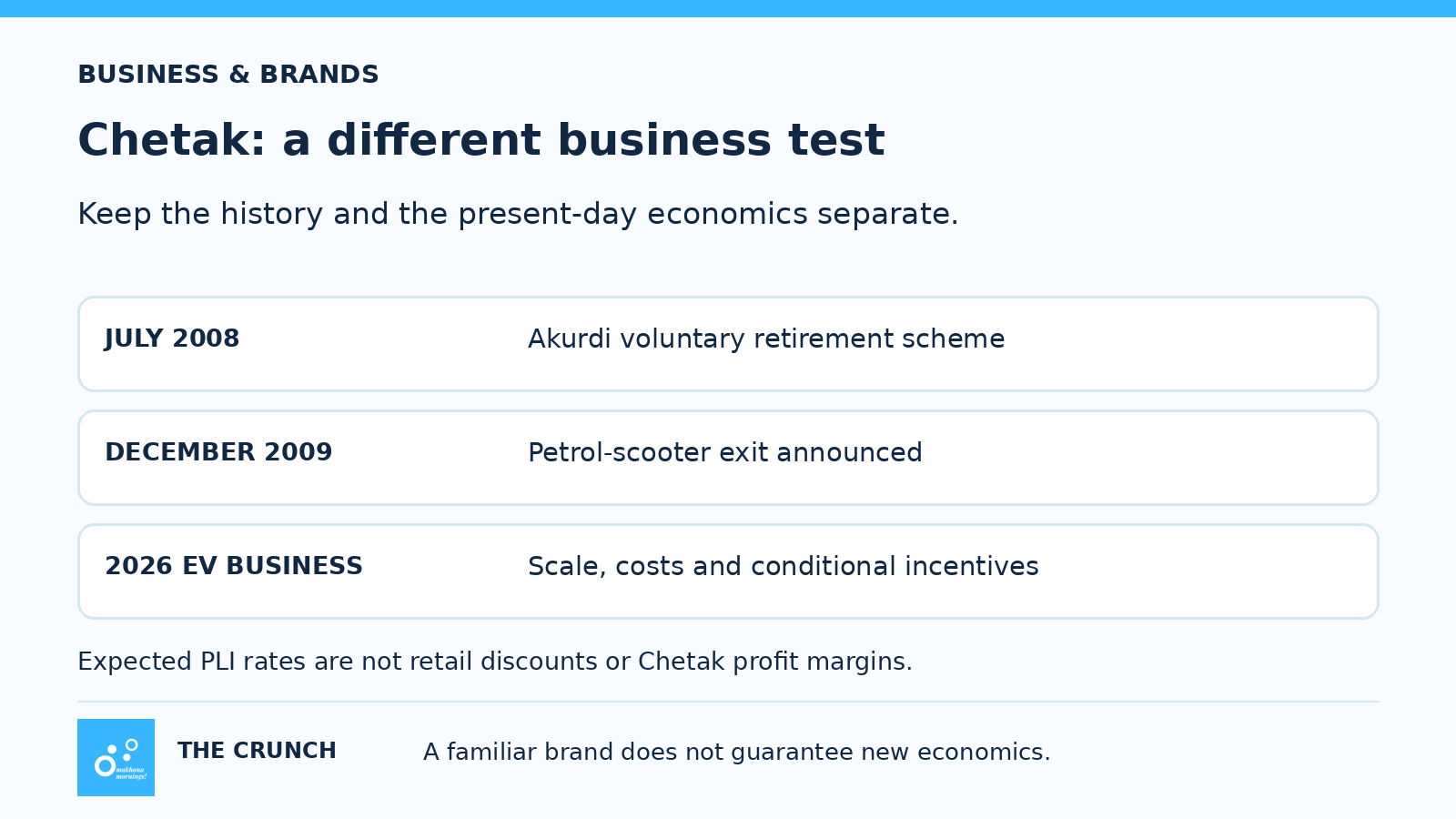
Leaving a category does not mean it will never be attractive again. Bajaj’s journey from exiting petrol scooters to building electric Chetak illustrates the distinction: a familiar customer need can return with different technology and economics.
The useful question is not whether the original exit was vindicated. It is whether the new business can keep improving as the support around it changes.
The Breakdown
Bajaj announced its scooter exit in December 2009, with production of its last model, Kristal, due to end by March 2010. The stated objective was to concentrate on motorcycles.
That decision should not be confused with the Akurdi voluntary retirement scheme. The scheme was announced in July 2008, and 2,331 employees opted for it. It preceded the scooter-exit announcement, rather than following it.
Nor does a subsequent increase in company profit prove that leaving scooters caused the improvement. A company-wide result cannot isolate the effect of one portfolio decision.
The New Test
On its October 27 earnings call this year, Bajaj said one million Chetaks were on the road. The company also said production-linked incentives were contributing to improved electric-business profitability, alongside other factors.
Management expected an 18% incentive rate on eligible electric-vehicle revenues in the second half of FY2027, comprising a 16% base rate and a two-percentage-point booster. That is not an 18% discount on every scooter’s retail price, or a standalone Chetak profit margin.
The government scheme currently covers eligible sales through FY2027–28, with the final corresponding disbursement scheduled for FY2028–29. Bajaj said it was working on platform-cost reductions to offset a substantial part of the eventual loss of that benefit. Those savings remain work in progress, not a completed replacement for incentives.
Why This Matters
The policy is designed to help manufacturers build scale and supply chains in advanced automotive technologies. Its commercial test goes beyond growing sales while support is available: investment should also improve the underlying product and cost structure.
For businesses considering a return to an abandoned market, the Chetak example suggests a useful discipline. Re-examine the economics rather than defending an old decision or assuming that a familiar brand guarantees success.
The Crunch
Bajaj has returned to scooters on different terms. The next chapter depends on execution, costs and competition, not on turning a complicated history into a simple lesson about quitting or persevering.
Leave your thoughts