
An electronics retailer can grow its sales without selling many more products. It can own stores without being debt-free. And a large turnover does not translate into an equally large profit margin.
Vijay Sales is a useful case study because its business is more complicated than a story about physical shops defeating e-commerce.
Start with the right numbers
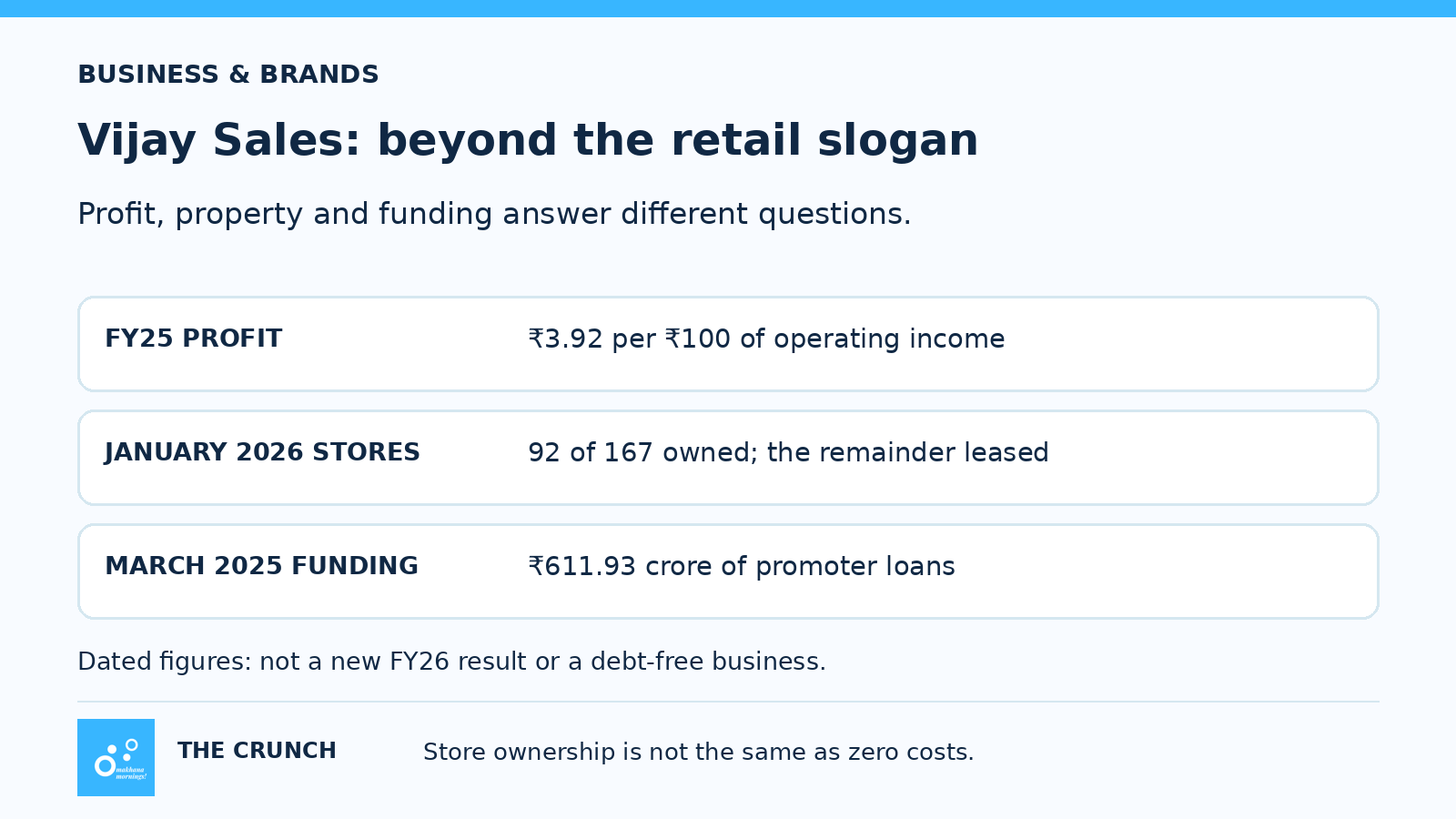
For FY2024–25, the company’s annual return records turnover of about ₹10,597 crore. Profit after tax was ₹414.90 crore, against ₹311.04 crore a year earlier.
That puts profit at roughly ₹3.92 for every ₹100 of operating income. It is a substantial business, but one where stock selection, funding and execution matter. These are FY25 figures, not a newly announced FY26 result.
The economics behind the showroom
As of January 2026, 92 of the chain’s 167 stores were owned, with the remainder leased. Ownership changes the balance between rent and capital committed to property; it does not make premises costless.
Promoter funding is another important distinction. The business had ₹611.93 crore of promoter loans outstanding at March 2025. Most debt consisted of interest-free promoter funding. That supports a different financing model from heavy reliance on outside lenders, but it is not the same as having no debt.
Its reported operating cycle was 12 days. This measures the working-capital cycle, not the shelf life of every product or a promise that all inventory sells within 12 days.
The customer journey is not purely physical
Vijay Sales also runs its own online store. Its published buying process covers online ordering, delivery and support. For installation, the company’s policy points customers to manufacturers’ authorised service providers, rather than claiming every service is performed by its own staff.
The analytical lesson is that a retailer’s role extends beyond displaying a product. Customers still have to select the right model, complete payment, receive it and arrange any required installation. A website and a store can be parts of that journey rather than opposing business models.
A timely reality check
In November, director Nilesh Gupta reported approximately 15% growth in sales value for October 9–November 10, while volumes increased only 5–7%. He described cautious spending amid higher electronics prices. That trading-period account is not an audited annual result, but it shows why rupee growth alone can overstate the strength of demand.
The Crunch
Vijay Sales is not evidence that physical retail automatically wins. It is evidence that a large retail business can coexist with e-commerce, while its financial performance depends on margins, working capital and funding choices. Those are more useful questions than a headline valuation without a verified transaction behind it.
Leave your thoughts