makhana mornings!

A little context. A lot to think about.

BUSINESS. PEOPLE. THE BIGGER PICTURE.

Clarity for a world that doesn’t slow down.

Why DMart is opening more stores while making its online map smaller

4 minutes

DMart’s physical stores and online grocery network are following different paths. The reason lies in the work and cost of serving each customer.

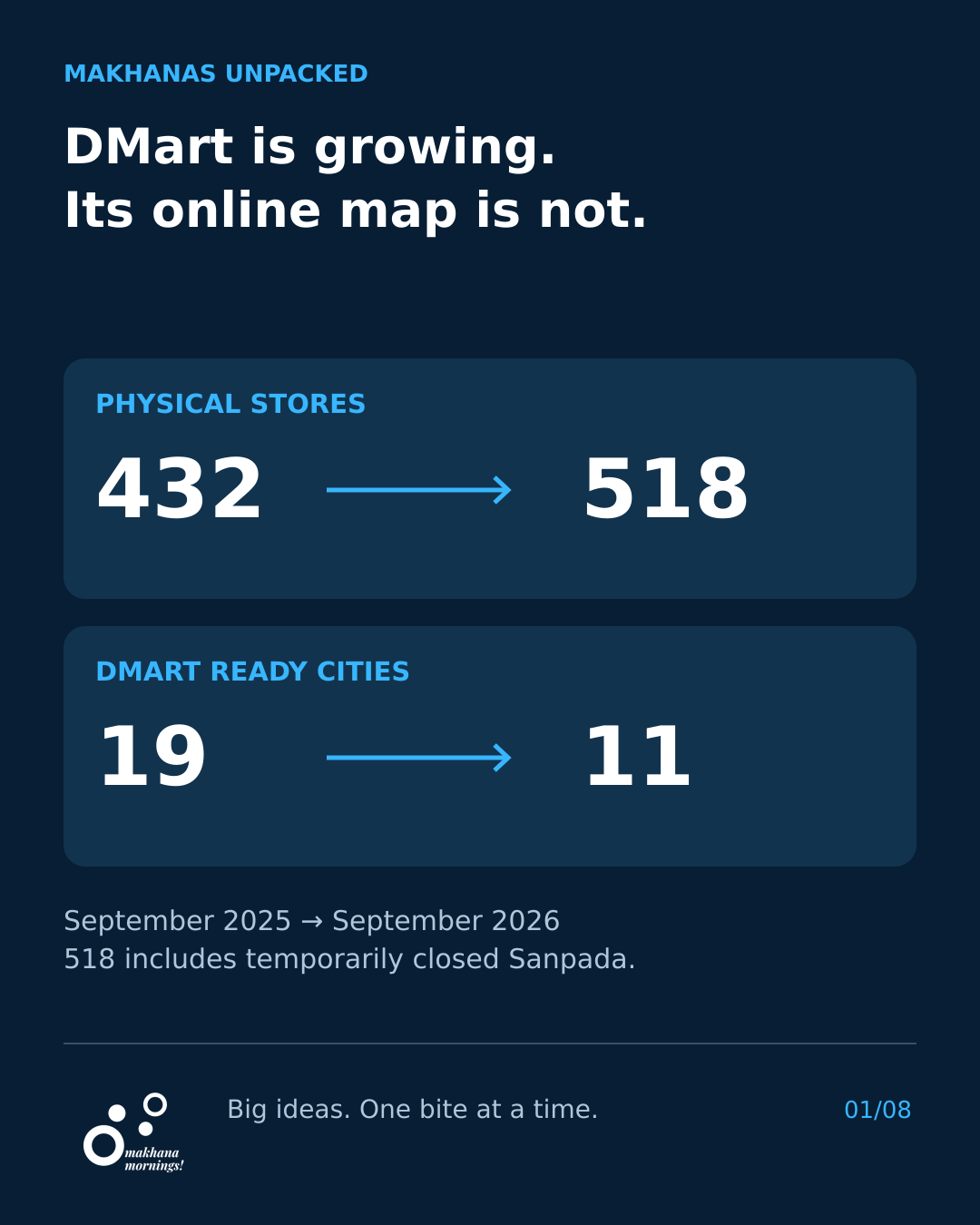
Physical stores rose from 432 to 518 while DMart Ready cities fell from 19 to 11 between September 2025 and September 2026; store total includes temporarily closed Sanpada.

A retailer can expand and contract at the same time without contradicting itself. DMart offers a useful example: its physical network grew while its online grocery service concentrated on fewer cities.

At the end of September 2026, DMart reported 518 stores, compared with 432 a year earlier. That total included its Sanpada store, temporarily closed for reconstruction. Over the same comparison, DMart Ready’s coverage fell from 19 cities to 11.

Physical-store comparison at September end: 432 in 2025, 518 in 2026. Company describes cluster-based expansion. 518 includes Sanpada temporarily closed for reconstruction.

The interesting question is not whether offline has beaten online. It is why the same company needs different answers to the cost of serving a customer.

The Breakdown

DMart describes its physical-store model as low everyday prices supported by low operating costs. Its stated ingredients include clustered expansion, store ownership and bulk purchasing through vendor-friendly policies.

DMart Ready cities reduced from 19 to 11 between September 2025 and September 2026. In July 2026 management said retained cities generated most online business and it wanted to prove a sustainable model there first.

The distinction matters. A discount is a number on a shelf. A cost model is the system that must make that number affordable to the retailer.

Online shopping changes the work involved. In a self-service shop, customers select their purchases and arrange the journey home. For a delivered order, those activities become fulfilment tasks. Picking, packing and transport must be covered somewhere in the economics, whether through merchandise margins, fees or other revenue.

This does not make delivery inherently unprofitable. It makes the size of the basket, the number of orders served from a location and the cost of fulfilling them important. More cities do not automatically mean a better business if the additional demand cannot support the additional work.

General operating comparison: in self-service shopping customers select goods and take them home; delivered orders require fulfilment picking and packing plus delivery. This is not proprietary DMart cost data.
Three general drivers of delivered-order economics: basket size and merchandise margin; local order density; cost of picking, packing and transport. No DMart unit-cost values are asserted.

The decision behind the smaller map

In July, management said the 11 retained cities accounted for most of DMart Ready’s business. It wanted to establish a sustainable, profitable model there first.

The plan was not simply to do less. Management described a more suitable online assortment, a better shopping interface and a goal of reaching most customers within six hours. That delivery goal was an ambition, not a guarantee for every order.

July 2026 management priorities: tailor online assortment, improve user interface and aim to deliver to most customers within six hours. The delivery timeframe is a goal, not a guaranteed current service level.

There was a financial reason to demand proof. Avenue E-Commerce, the subsidiary behind DMart Ready, reported FY26 revenue of about ₹4,094 crore and a loss of about ₹307 crore. A substantial sales business was not yet a profitable one.

Avenue E-Commerce FY2025–26 revenue was 4,093.61 crore rupees and loss after tax was 306.53 crore rupees. Figures are displayed separately rather than as proportionate areas.

Why This Matters

For shoppers, price and convenience are separate benefits. A household stocking up and a household replacing one missing ingredient may value them differently. Neither shopping occasion establishes one universally winning format.

For businesses, DMart’s decision illustrates a more useful question than how quickly a footprint can grow: which parts of the operation are ready to be repeated, and which still need fixing?

The Crunch

A larger store network and a smaller online map can belong to the same strategy. The test is whether concentrating demand improves service and economics, not whether the map looks impressive. DMart has stated what it wants to prove. The smaller footprint alone does not prove it has succeeded.

Conclusion: ask which part of a business is ready to scale and which still needs improvement. More physical stores and fewer online cities reflect different operating models. A smaller footprint does not prove profitability.

Related reading: how Asian Paints built an advantage beyond paint, and how Tanishq made old gold a reason to enter a store.
Leave your thoughts

You might also like…