
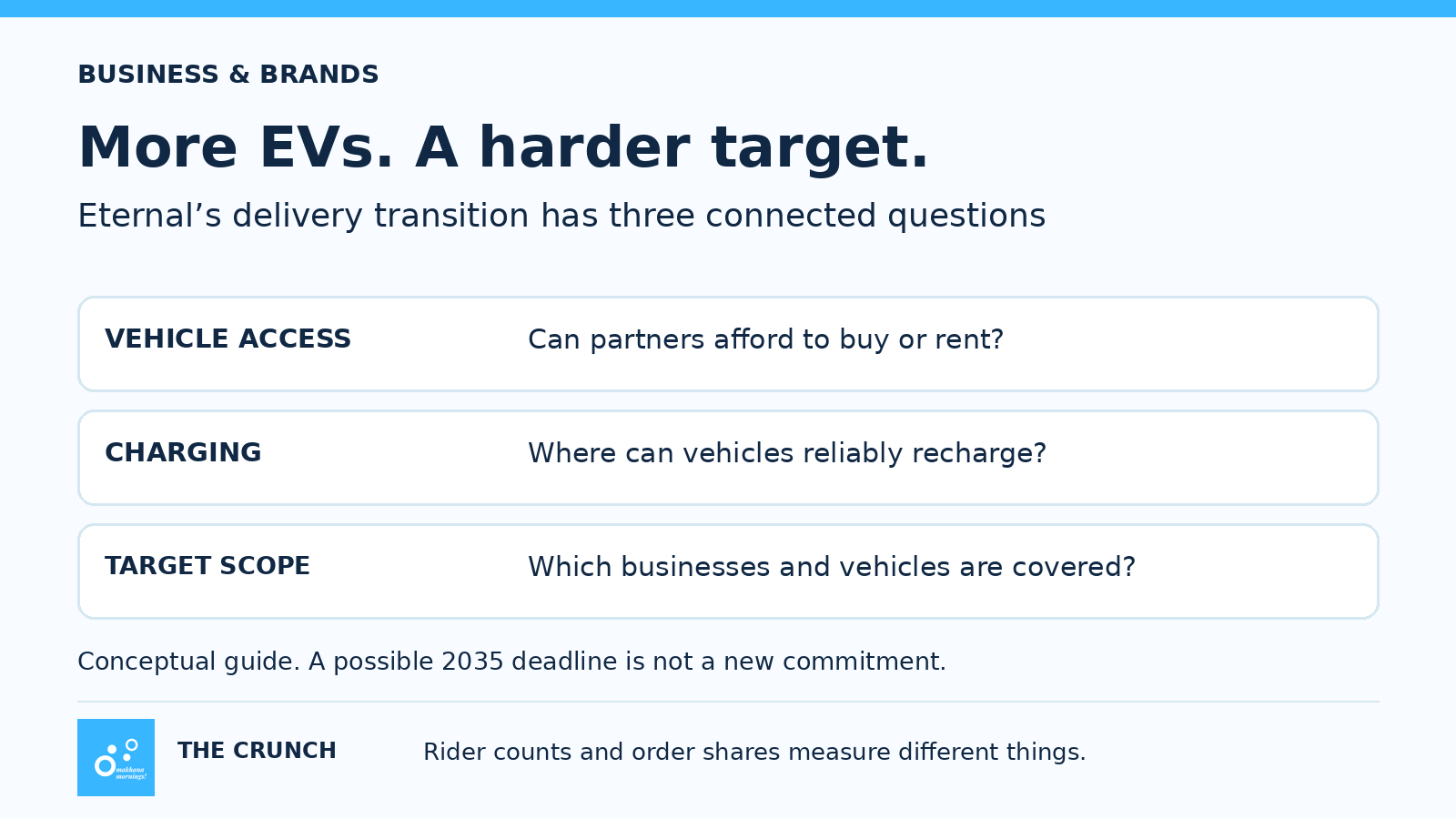
An electric delivery fleet can grow while a promise to make every delivery electric remains difficult to achieve. Eternal’s reassessment of its 2030 ambition illustrates the gap between adding EVs and making them a workable choice across an expanding business.
In an interview published on November 15, chief sustainability officer Anjalli Ravi Kumar said Eternal was working towards a revised timeline. A possible 2035 date was discussed, but she did not announce it as a new commitment. She said a group-wide target would need to accommodate Hyperpure’s trucks and smaller commercial vehicles, not just two-wheelers.
The Breakdown
This is not a newly disclosed retreat. Eternal’s FY26 annual report had already said it intended to revise its EV and net-zero goals. Kumar also discussed the difficulty of meeting 2030 in an interview published in August.
The earlier ambition was framed around food delivery. Eternal’s climate webpage still describes a goal of facilitating 100% EV-based food deliveries by 2030. That is narrower than saying every vehicle used by every group business must be electric.
Progress also needs a clear denominator. The annual report records 132.3 million EV-based food orders in FY26, representing 13.5% of food-delivery orders. Separately, it reports more than one lakh EV-based delivery partners across the wider business.
Those figures answer different questions. A count of riders using EVs is not the percentage of orders they deliver. Nor should food-delivery progress automatically be read as progress across grocery delivery and business supplies.
Why a cheaper journey may still be a difficult purchase
For a delivery partner, the relevant calculation is not simply electricity versus petrol. It is whether buying or renting a vehicle makes sense for the hours they expect to work, and whether they can keep it running reliably.
Eternal’s annual report identifies part-time participation, costly or restricted credit, and charging gaps outside major cities as obstacles. These are the company’s assessment, not proof that every rider faces the same constraints.
In the August interview, Kumar described another practical problem: installing charging or battery-swapping facilities at a warehouse or dark store can require permission for additional electrical capacity. She said obtaining those permissions had been difficult in many cases.
That connects a vehicle decision to the building and power network around it. An available electric bike does not, by itself, settle where a rider can recharge, how long that takes or who pays for the infrastructure.
The Big Picture
Eternal says its approach is to encourage EV adoption rather than impose a particular vehicle choice. That matters for a platform whose delivery partners generally arrange their own vehicles.
The useful test for a revised target is therefore more demanding than whether its deadline moves. Readers should look for a clearly defined business scope, a consistent measure of progress and intermediate milestones. A group-wide transport ambition should explain how two-wheelers, commercial vehicles and different delivery operations fit together.
It should also distinguish access to an EV from ownership. Rental and financing arrangements may address different needs; neither should be treated as universally affordable without examining its terms.
The Crunch
The question is not whether Eternal has added electric deliveries. It has. The harder question is whether its next commitment will explain how access can spread across its businesses without making participation unaffordable for delivery partners. Until that plan is announced, 2035 remains a possibility, not a replacement deadline.
Related categories: People & Work; Infrastructure & Manufacturing
Leave your thoughts