
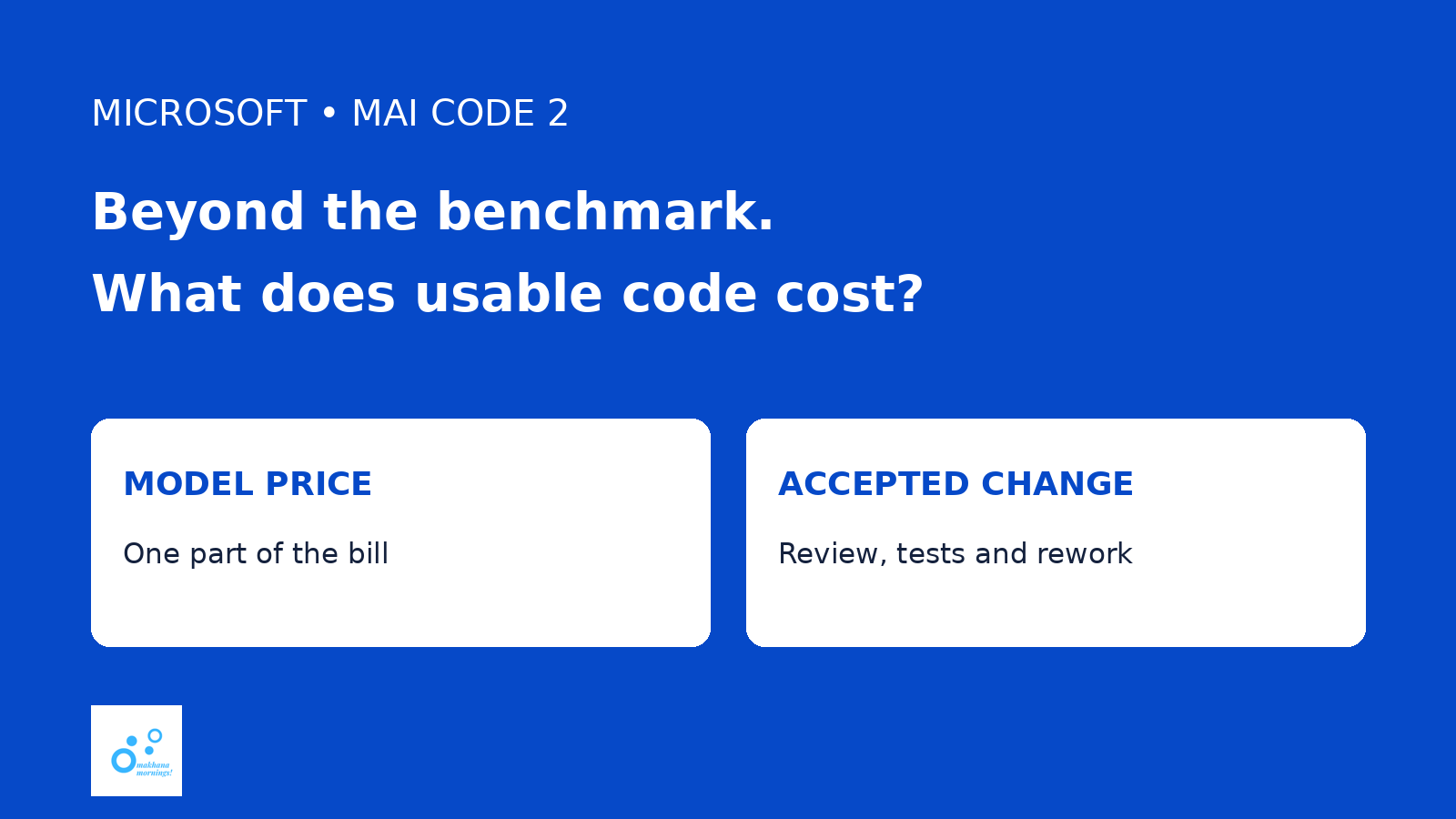
A cheaper coding model is not automatically a cheaper finished software change. Microsoft’s new MAI Code 2 models make that distinction worth testing, especially for teams weighing model charges against the time spent checking and repairing output.
The Breakdown
Microsoft’s November 17 announcement says MAI Code 2 and Code 2 Flash are available in GitHub Copilot. Flash also has a limited-access preview in Microsoft Foundry. The company positions Code 2 for broader implementation and debugging, and Flash for routine, high-volume tasks.
The price-performance comparisons have important conditions. Microsoft uses specified coding benchmarks at maximum reasoning effort. Three run through its internal evaluation platform and Copilot CLI without subagents. The cost figures use 50% promotional pricing.
Microsoft also says these models are not yet tuned for fundamental-science research or very long-running agentic work. These are bounded product claims, not proof that one model is best for every software task.
Why This Matters
For an Indian engineering team, a useful trial would compare similar jobs in its own codebase. Record whether the proposed change passes tests, how much review it requires, whether it needs another attempt and what the completed task costs. Keep the acceptance standard fixed rather than counting every generated answer as a success.
The inference is straightforward: a low model charge can be valuable, but repeated correction can change the economics. Conversely, a modest model may be entirely adequate for a well-defined task. Neither outcome can be established from a benchmark average alone.
The Crunch
Compare the cost of accepted work, not just the advertised price of generation. Check the pricing period as well as the workload before turning a promotional comparison into a recurring budget assumption.
Leave your thoughts