
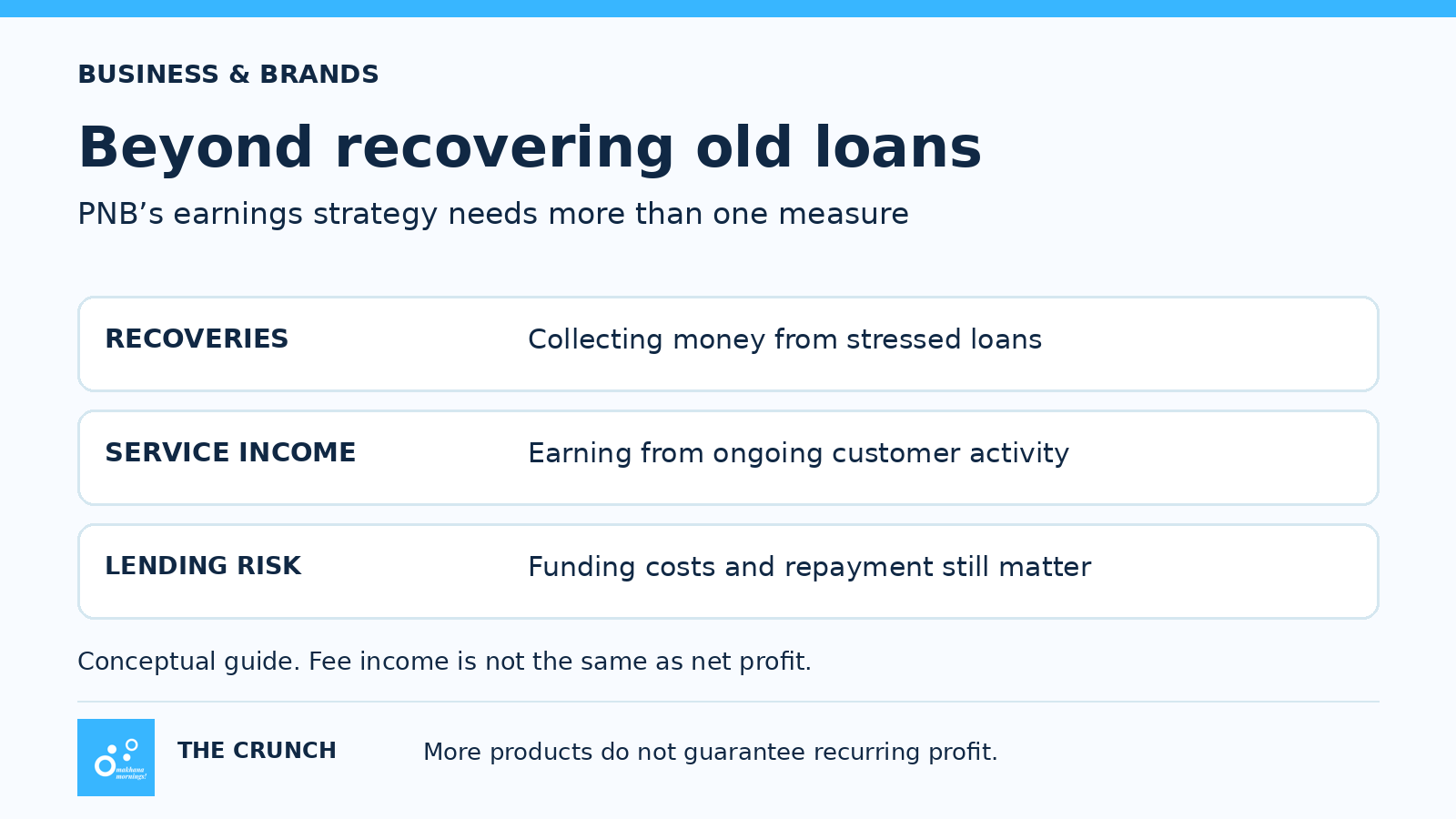
Recovering money from a bad loan helps a bank. Building a business that does not depend on a large stock of bad loans to recover is a different task.
Punjab National Bank’s renewed emphasis on credit cards, cash management and supply-chain finance brings that distinction into focus. Its management is looking beyond the immediate benefit of cleaning up the loan book to the services that could support earnings afterwards.
The Breakdown
In its results for July–September 2026, released on October 16, PNB reported net profit of ₹5,532 crore, up 12.8% from a year earlier. Fee-based income increased 16% to ₹1,954 crore. Its gross non-performing asset ratio fell to 2.55%, from 3.45% a year earlier.
Those figures describe different parts of the business. Fee income is revenue from services, not the profit left after the bank’s costs and other charges. A falling bad-loan ratio is an asset-quality measure, not a measure of demand for those services.
Management has explicitly connected the two sides of its strategy. On the October earnings call, managing director and chief executive Ashok Chandra said recoveries would decline in coming years as fewer loans became stressed. He identified cards, supply-chain finance and cash management as businesses intended to support profitability as the contribution from recoveries or treasury earnings falls.
His latest comments, reported on November 15, reaffirm that focus. This is an ongoing strategy, not three businesses launched today.
What the bank is selling
Cash management here means helping businesses collect, pay and keep track of money. PNB’s offering includes matching receipts against invoices, managing collections through virtual accounts, and processing salary or vendor payments.
For a business customer, the value is not simply moving money. It is knowing which customer paid which invoice and reducing the work needed to reconcile the accounts.
Supply-chain finance answers a different need. PNB describes short-term working-capital financing for dealers and suppliers linked to larger corporate customers. That remains lending, with funding costs and repayment risk; it should not all be treated as fee-only revenue.
Credit cards also combine payment services with credit. More cards issued do not automatically establish more profitable customers.
Why This Matters
The useful distinction is between improving the legacy loan book and earning from ongoing customer activity. Both can matter, but one does not prove the other.
Nor does a digital platform guarantee recurring profit. Customers must use it, the service must work reliably, and income must cover delivery costs. Where credit is involved, repayment performance still matters.
PNB’s fee-income growth is evidence of progress at the bank-wide level. It does not establish the profit contribution of each new vertical or prove that they can fully replace any future decline in recoveries.
The Crunch
PNB’s challenge is not just collecting yesterday’s unpaid loans. It is building services that customers keep using tomorrow.
Watch fee income, customer activity, service costs and credit quality together. A larger product portfolio is the starting point, not the earnings outcome.
Related categories: Economy & Markets
Leave your thoughts